

Many of you have asked me if I could talk about things I have learned in therapy since I announced back in the summer that I was going back into therapy for my struggles with anxiety.
Well, first off, I didn’t end up going right away. It took me about 1.5 months to find a therapist who would fit my budget. After a long search, I found a very nice lady who offers a sliding scale because her therapy office is based out of a church. I had almost given up on it and then was thrilled when I found her.
My therapist uses a multimodal approach with a focus on Cognitive Behavioural Therapy, which helps us understand how our thoughts and feelings influence our behaviours. CBT was also one of my favourite forms of therapy that I learned about in grad school.
We all have thoughts that tend to be so automatic we don’t question or challenge them. For example, “I’ll never be able to find a job that I love because I’m not exceptional at anything.” or “It must be my fault that they don’t like me because there’s something wrong with me.” It’s amazing when you stop and think about how many negative thoughts go through the mind each day.
CBT helps bring awareness to these thoughts that lead us to have incorrect beliefs about ourselves and our situations. In the past, I’ve had great success when using CBT methods, especially when in recovery for my eating disorder.
In therapy, we’ve been able to identify that a large part of my anxiety is due to personal issues from my past and also that I make false assumptions and predictions about events in the future. I tend to predict that a situation will go poorly, when in fact, I have no evidence that this is the case.
One of my favourite forms of CBT is the Thought Record. The great thing about it is that it can be used by anyone, anywhere.
The Thought Record has been very helpful for me to reframe automatic thoughts. The more you use it, the easier it is to fill out and catch your negative thoughts in the process. Once you practice, you can even start doing it in your head if you find yourself in the middle of an anxiety-provoking situation.
If you click the image below, the Thought Record will pop up in PDF format that you can print for yourself.
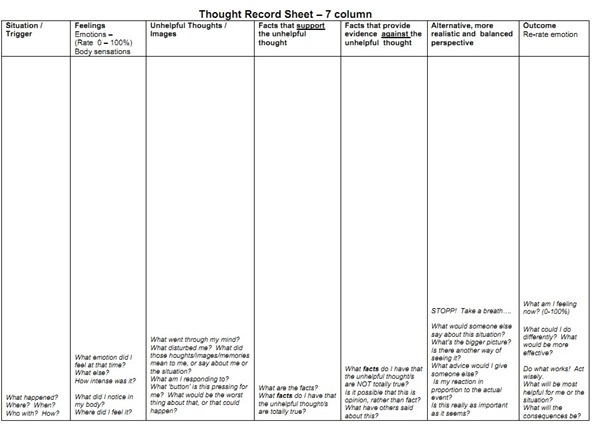
Here’s an example of what each column means:
1. The situation/trigger. Briefly describe the situation that led to your unpleasant feelings.
For example, “a work presentation”.
2. Feelings. What do you feel?
For example, “Anxiety, guilt, doubt, fear.”
3. Unhelpful thoughts/images. Identify the negative thinking (or “hot thought”) behind your feelings.
For example, “My presentation is going to go horrible and my boss is going to think that I’m bad at my job. I’m a failure.”
4. Facts that support the thought. Find evidence that supports your unhelpful thought.
For example, “My boss has told me in the past that she’s disappointed with my presentation skills.” and “I didn’t prepare as much as I should have.”
5. Facts that don’t support the thought. Facts that provide evidence against your unhelpful thought.
For example, “I have worked on my presentation skills since my poor review and I have improved.” and “I’m not a failure and I’m doing my best.” and “Everyone has bad days at work.”
6. Give an alternative/more balance thought. Now that you’ve considered the facts, write down a healthier way of thinking.
For example, “While I have struggled with presentations before, I’ve practiced and prepared for this presentation and have no proof that this will not go well.”
7. Outcome. Re-rate how you feel now.
“Less anxious” “calmer” “reassured”
That’s just one small example that it can be used for, but it can be applied to so many different types of situations, thoughts, and personal struggles. It’s a really helpful tool to use for body image issues because many of us tend to have automatic negative thoughts about our body that can impact our entire day. Sometimes all you need is to re-frame your thought and move on with your day.
Of course, it takes a bit of practice to be able to reframe a thought (and find evidence that doesn’t support it), but it will get easier over time. Also, not every thought record that you do is going to be life-changing, but I can assure you that some of the ones I have done have really impacted me.
The first time I did the thought record with my therapist, I had this major ‘a-ha’ moment. She helped me write a more balanced thought (I actually couldn’t think of one, so she filled one out for me) and it brought me to tears because something just clicked inside of me. It was amazing how it helped me see a situation in a new light that I’d never thought about before. That one moment has had a huge impact on how I now think about the situation.
The Thought Record makes my thoughts more realistic and balanced, when anxiety tends to make them very up and down and unbalanced. With practice it helps you slow down or stop those automatic thoughts in their tracks. I find that I can “catch” them fairly quick now, recognize them for what they are, and realize that my thinking is not realistic or fair. It sure beats going along in life accepting every negative thought that comes to mind.
If you feel yourself stuck on an issue, try using the Thought Record. It may just help you see something in a new way!







angela i am so happy you wrote this post. so many of us struggle with issues similar to yours but are not brave enough to proactively seek help. thank you for always being a inspiration for strength.
CBT is a great tool. I go through anxiety as well and my therapist taught me one method called the HALT method whenever something I start to panic or get really anxious about something. I found a lot of the times there were other things that weer triggering the intensity of what I was feeling, and HALT can help you figure that out. You ask yourself: Am I Hungry, Angry, Lonely or Tired. When you start to think it out and reason with yourself, anxiety kind of dissipates and you feel a little more sane :) It has helped me out quite a bit.
-Sush
I love that!
Hi Angela,
I am new to your blog, but I’ve already made a bunch of your recipes and loved them (my favorites being the pumpkin pie brownie and the pumpkin gingerbread smoothie–OMG so good). Thanks for this post. As a fellow anxiety-struggler, I really appreciate your openness about the topic. Anxiety is a mean and scary monster, but learning to identify negative thought patterns is half the battle.
Thanks for posting this Angela. Your openness and willingness to share such personal issues is what makes your blog so special. You have helped me immensely and I’m sure you’ve helped many others too.
Thanks, that is sweet!
Interesting! As a social science nerd, I always like reading about this kind of stuff. :)
Thank you for this! I’m going to give the thought sheet a try.
I’ve been talking to my counselor again about anxiety, too, & she’s really been helping me put perspective into it. For example, I had a particularly hard time asking for help awhile ago (I often do, but this time I was becoming bitter), so I talked to her about it. I realized that this was an OLD fear, a fear of asking for help, and though it used to be a real one, it’s not realistic for the people who are in my life NOW. Since then, I’ve been able to ask for help without fear.
It’s interesting how the brain can hold onto old thought patterns, and it can be tough to break through them sometimes. I’m just thankful for self-awareness, and thankful that I’m not the only one who struggles. Have a beautiful day, Angela :)
This is fantastic, good for you girl! I completely believe this will work, it’s all just about adjusting your instantaneous negative thoughts and replacing them with more truthful and positive ones. Interested to see how well it works over time! :)
What an eye-opening story – thank you so much for sharing your struggles and how you are coping with it. There’s many people out there going through similar issues (including me) and aren’t brave enough to be open. Salute to your honesty and bravery :D
I am a big proponent of thought records–the concept can be adapted to appeal to many people. I plan on using them when I am an official counsellor (i.e., once I graduate from my MEd in Counselling Psychology). Thanks for posting this…anxiety is so prevalent and people can benefit so much from talking to someone and/or employing coping strategies. I personally find exercise and eating healthfully, in addition to positive self-speak, is key.
–Jaclyn T
TrickArt Jewellery: Nature Inspired
http://www.etsy.com/shop/trickartjewellery
http://www.positiveponderings.blogspot.com
I also struggle with anxiety, where abouts is this lady? (I live in Ontario as well)
Dealing with my anxiety is one of the hardest things I do in a day. I think when it hits me my mind is racing so quickly I don’t know if I could actually force myself to stop and take myself out of it. Well, I’m trying at least. I’m just not always successful. This does look like a good tool to get myself in the right direction.
What a great post. I recently visited an intuitive, energetic healer and she helped me realize that I was even having these negative thoughts in the first place! The thinking was so ingrained in my head I didn’t even realize it was happening. I really like the idea of a thought record – it’s a concrete way for me to reframe my negative thought patterns.
I absolutely loved this post (as always). I’ve bookmarked it and will be visiting it often when I need the reminder!
That is really nice. I like how you have become a teacher of much more than food!
Thank you so much for sharing posts like this! I struggle with anxiety and negative thinking too. I’m trying to find a therapist in my area that I can afford but in the meantime I’m working on recognizing my negative thinking and re-framing how I think about things. I’m definitely going to be using the thought record!
Thank you so much, I needed something like this.
Also, I’m so glad you’ve found help and are doing what’s best for you to be happier.
This was fantastic…I came here originally for the wonderful recipes, but the realistic and honest approach to understanding life and how to deal with it is refreshing.
Thank you David!
This is a great post Angela- as a therapist, I know CBT helps many people – it is nice to have something concrete to work with. I also would reinforce the necessity of dealing with the core issues – as you noted – since our negative thinking does not come from nowhere! Once you deal with these, and you change the thought patterns – you are more free to be truly who you are in your essence. That is a beautiful thing…and it is phenomenal that you share your process in such a respectful and authentic way. Thank you
Thank you Suzanne! I totally agree about addressing core issues…without it, I don’t think real progress can happen.
Yes, as my therapist says, “If we are not walking on water…we are not done yet”.(I feel it is crucial as a therapist to stay on top of my own ‘stuff’ – and there is an endless amount of it!) It is one of the rewards and challenges of this life to release our outer layers so we can let our inner selves shine as we are meant to.
Another suggestion which is infinitely helpful… and effortless, is guided imagery. Belleruth Naparstek is AMAZING and has a CD /audio for anxiety as well. It is a mind-body -spirit method of going into your subconscious and changing old patterns. The best is that you can listen to it as you go to sleep and it still goes into your subconscious and does its work (plus makes you sleep better too). Her website is healthjourneys.com.
This is a powerful tool.
I have struggled with fairly severe anxiety since childhood (panic disorder and agoraphobia). Though I now have my anxiety issues largely under control, I’ve recently realized how often I subconsciously orchestrate my life to reduce stress and potential “triggers”. I have walked through many exercises that have helped, but this is a new one that seems to have a lot of potential (even for those “little” moments when I feel flashes of worry).
Thank you for sharing!
Thank you for this post. I have just started CBT based therapy about 6 months ago and it has been incredibly difficult to overcome this level of anxiety. It is so helpful to read someone else’s experience with this too and the pdf you provided isn’t something I’ve seen before, but may help me make the process I’m learning in therapy more concrete.