
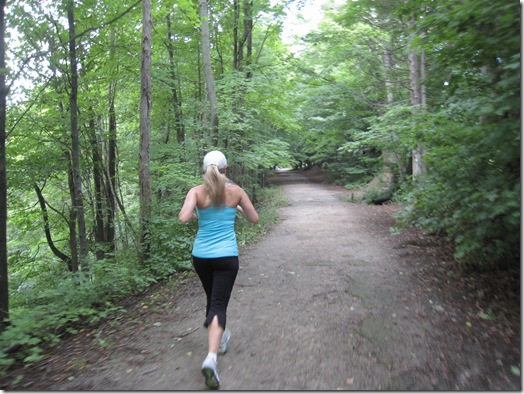
For whatever reason, I always approached running with the mindset that walking equaled giving up. As soon as I could run continuously for x amount of miles, I decided there was no reason to stop and walk. This mindset didn’t start to change until I participated in my first two races.
During the races, I would pass by some runners who had stopped to walk. I remember thinking to myself that something must be wrong (injury??) or they had lost their steam. Well, was I ever surprised to see them blow right by me once they started running again! I started to wonder if walking breaks could help my own performance.
Recently, I started to look into the Galloway Method. Jeff Galloway is a former Olympian and has coached over 200,000 runners and walkers to improve their running performance.
The Galloway Method is based on the premise that regular walking breaks improve your performance.
Jeff says, “Most runners will record significantly faster times when they take walk breaks because they don’t slow down at the end of a long run.”
How does it work?
Walk breaks work because walking and running distributes the workload among a variety of muscles, rather than placing all the workload on the running muscles entirely.
He says, “Walk breaks will significantly speed up recovery because there is less damage to repair. The early walk breaks erase fatigue, and the later walk breaks will reduce or eliminate overuse muscle breakdown.”
When to take walk breaks?
Walk breaks will give you the most benefit during your long runs and he says that you may not need to take walk breaks during shorter runs (of course, depending upon your level). To receive the most benefit, you must take walk breaks before you even start to feel fatigued. He suggests taking your first walk break during the first mile.
Run-walk-run ratio should correspond to the training pace used:
8 min/mi—run 4 min/walk 35 seconds
9 min/mi— 4 min run-1 min walk
10 min/mi—-3:1
11 min/mi—2:30-1
12 min/mi—-2:1
13 min/mi—-1:1
14 min/mi—30 sec run/30 sec walk
15 min/mi—30 sec/45 sec
16 min/mi—30 sec/60 sec
For beginners, the 30 seconds of running with 60 seconds of walking might be a great place to start and then build your way up.
On my previous long runs, I typically run around a 9:30 min/mile pace, so my walk/run would look something like this:
- 3:30 min. of running
- 1 minute walk
- 3:30 min. of running
- 1 minute walk
- etc
Coming from someone who never used to take walk breaks, this seems like it will be a hard challenge for me to do. Personally, I think I may adapt better to the Running Room’s 10:1 program.
My initial findings with walk breaks
Over the past week, I have been experimenting a bit with walking breaks. I haven’t started to follow any set method because I just wanted to get a feel for it and see if I could notice any changes to my overall time/pace.
On Wednesday, I ran a hilly 8 miles with an average pace of 9:43 min/mile. I took about 7 quick walk breaks (approx. 45 sec.) during the run.
Then yesterday I ran 7.25 miles (same hilly route) with hubby (on bike) and I took just 1 walk break (after murder hill). My average pace for the run was 9:54 min/mile. Which is even more surprising because 1) I had water and was hydrated (on Eric’s bike), 2) It was cooler/cloudy, and 3) The run was shorter.
It appears that Wednesday’s run, even with lots of walk breaks, seemed to improve my overall pace.
I am going to experiment some more with walking breaks and continue to monitor if my overall pace improves. It seems counterintuitive that walking could improve pace, but I have heard from a few people that they actually run much faster when they give their body a break.
Jeff offers this advice on figuring out the proper amount of walking:
“Don’t get too rigidly locked into a specific ratio of walk breaks, adjust as needed. Even if you run the same distance every day, you’ll find that you’ll need to vary the walk break frequency to adjust for speed, hills, heat, humidity, time off from training, etc. If you anticipate that your run will be more difficult or will produce a longer recovery, take more frequent walk breaks (or longer walks) and you may be surprised at how quickly you recover.”
How do you approach running? Do you like to take walking breaks? Or do you prefer to just run as long as you can without stopping? Have you ever changed up the way you run and how did it affect your performance?

Try a thing you haven’t done three times. Once, to get over the fear of doing it. Twice, to learn how to do it. And a third time, to figure out whether you like it or not.
—Virgil Garnett Thomson




I just started doing this on my longer runs. I have read 2 of Jeff Galloway’s book, including the half marathon one. I was only doing walk breaks towards the end of my long run, but may start them now in my first mile. I ran 10 miles on Saturday (with 2-3 walk breaks) in 1h 32min & 33 sec. Avg. pace 9:15/mile. I would like to see what the difference is with the earlier walk breaks.
Thanks for posting this! Love the quote at the end!!
I think walking breaks are really important; I always take them. I find my runs are quicker and easier when I do, too!
The one caveat worth thinking about:
Are you (a universal, not aimed at you specifically) training to be a RUNNER or training to run?
A runner doesn’t walk. Period. You don’t see Olympians do it, you don’t see fast runners do it, you don’t see even not so fast runners who define themselves by running doing it. You just DON’T DO IT. This is why many runners HATE Galloway: it takes away from the integrity of the sport to plan walk breaks. (Competitive walkers hate Galloway too for the same reason…they walk the whole damn thing at that pace, combining the two is kind of an insult to competitive walkers.)
On the other hand, if you want to be fit and have a program that includes running? Walking makes sense. If fitness is the end goal and speed is not so important (you’re not gonna win any races with walk breaks), then its a great idea.
Bottom line: like any other training program, your end goal is a big consideration.
How many of us are going to make the Olympics ? This is a silly analogy. If you jog an entire race at a slow pace ie; 8 to 9km/h and have a worst time then if you took small breaks resulting in quicker running pace say 10 to 12km/h, why not do the latter ?
Since I normally don’t run over 5 miles I don’t think I need a walking break. But this method sounds so interesting. I think if I used it, I would be able to run longer and faster. Terrific topic Ange!
I have many marathoning friends that have cut minutes off their time (I have heard that the JF method on average cuts 6 minutes off your marathon time).
However, the only reason I don’t do that is because I DO stop to walk – during water stops – but following a specific “run a mile, walk 1 minute” etc plan doesn’t usually coincide with the water stations at the race :)
I’m going on a run tonight and I am going to use this! :D AWESOME! Thanks!
I’m really excited to try out the 10:1 in my run tomorrow! I will report back of course. :) ~A
I really like that quote at the end of your post. So true
I’m a horrible runner, so maybe this method would help me improve. I have what I refer to as “the bad knee” from surgery years ago, plus I honsestly think I was made to swim, not run. However, it’s such a great exercise and can be done almost anywhere with little cost!
have always used walking breaks.. usually 9/1 but sometimes run up to 14/1 and as short as 5/1, depending on how I feel. Keep trying, it is great.
I think it is a great method! I am still learning to run using intervals, building up gradually to run 30 mins straight. But I already figured that I am going back to intervals once I can handle a 5k without walking. Why? Just because I like the intervals: it’s a bit harder because you have to get going again every time. therefore you also burn a lot more calories than with just running. And once you get used to it, the ‘oh my god I have to get going again but my legs feel like lead/rubber’-feeling will fade too.
And I really like the fact that it actually speeds up you time!
interesting. maybe once my long runs start to get up in the mileage category for marathon training ill incorporate some walking and see how it works. my usual view is that I dont like taking walking breaks- i tell myself that i am tired i can run as slow as my heart desires but to not walk. seems to work…but im up to try anything!
oh and those muffins from the last post are making me drool..i bookmarked the recipe…i have to try it!!
I’ve used his method of traing for a couple years. I ran a half marathon for my 60th birthday and then my feet always hurt. I read about his method and tried it. Now my feet feel so much better and I’ve discovered days off are a good thing too. Of course you’re a lot younger then me. I truly enjoy your site and love the recipes that you share with us.
I think like you do…run and run the fastest you can with out stopping. Walking=failure to me in the past. But, yesterday after I read this, I tried the 10:1 method. And let me tell you…it was the best run I have had in a while. A little faster than normal, but I knew I had the break coming it encouraged me to run a little faster and harder. I felt great afterwards too! I am going to continue to do this and see if it really helps me to run longer and faster.
Thanks for the great topic!
i never walk when i run because i too see it as “giving up.” i definitely want to give this a try, though. thanks for sharing!
I’ve been ready your blog for a little while now, but this is my first time commenting. I just wanted to say I love the blog and find it interesting, inspiring and the recipes look delicious!
I’m glad you posted about this. I just looked into this a couple weeks ago. I’m currently only running 3-5 miles, so I didn’t think walking breaks were needed, but I’m struggling getting over that 5 mile mark and I think walking breaks might help. I’m going to try it and see how it goes!
Thanks again for posting about this topic!
Oops! I’ve been *reading* your blog, not *ready* your blog. hehe.
I hope those taste better than they look!
I know that walk breaks work wonders for a lot of people, I have jsut never found them to work for me. I think the issue is that I LOVE to walk…and I LOVE to run…so either I run or I walk, but I don’t mix them up or my body is all confused