
In my post, Replacing Dairy Milk, a few of you commented that you avoid several brands of non-dairy milk because they contain an ingredient called carrageenan. This was the first time I had heard anything about this ingredient, or at least the first time I took any notice. I assumed that it was a safe ingredient, especially because it is found in some organic products. But as we know, just because something is allowed in our food does not mean it’s necessarily good for us. It’s frustrating as a consumer to believe we are buying quality ingredients only to find out they could be harmful to our health.
Anyway, I knew I had to look into this further. And I don’t like what I’m reading. In fact, I’m pretty ticked off.
At first blush, carrageenan sounds seemingly harmless – it’s derived from red seaweed and is used as a thickener, stabilizer, and/or emulsifier in many dairy (sour cream, yogurt, ice cream, etc), dairy alternatives (non-dairy milk, non-dairy cheese, etc), and deli meat products. As it turns out, research links carrageenan to gastrointestinal inflammation, lesions, and even colon cancer in animals. Individuals with Inflammatory Bowel Disease or other gastrointestinal disorders are cautioned to avoid this ingredient as it can make symptoms – and inflammation – even worse. As someone who has suffered from IBS for many years, I was shocked to find this information out. This was the first I had heard of it.
For a review of the research on carrageenan see this PDF document by Cornucopia.org. Please look into this ingredient and make your own informed opinion.
For a long and detailed list of carrageenan in many dairy and non-dairy food products (and safe products as well), please see this Cornucopia shopping guide – it’s extremely helpful. You might be surprised at many of the brands that contain this ingredient. I know I sure was.
I realize there is no conclusive evidence with regard to human consumption of this ingredient, but I’m not willing to take that risk when there are other options, especially because I have suffered from IBS on and off for half my life. I will no longer support President’s Choice Organic Almond Milk or Blue Diamond’s Almond Breeze – two of several brands that contain carrageenan. Instead, I’m going to purchase Whole Foods 365 organic almond milk which is one of the carrageenan-free brands or I will make my own milk at home (more on this in my next post). I’m anxious to see if I notice a difference.
For the complete list of carrageenan-free products, be sure to check out the shopping guide linked above.
As I mentioned in my intro post, we have a lot to learn from each other and this is a perfect example. I’m thankful for all of you sharing your experiences and knowledge in the comments. I’m learning too. I hope that by writing about this today, more awareness is brought to this ingredient. With other thickeners/emulsifiers readily available (such as organic guar gum and organic locust bean gum) there is no excuse for food businesses to continue to put carrageenan into our food at the potential risk of our health.
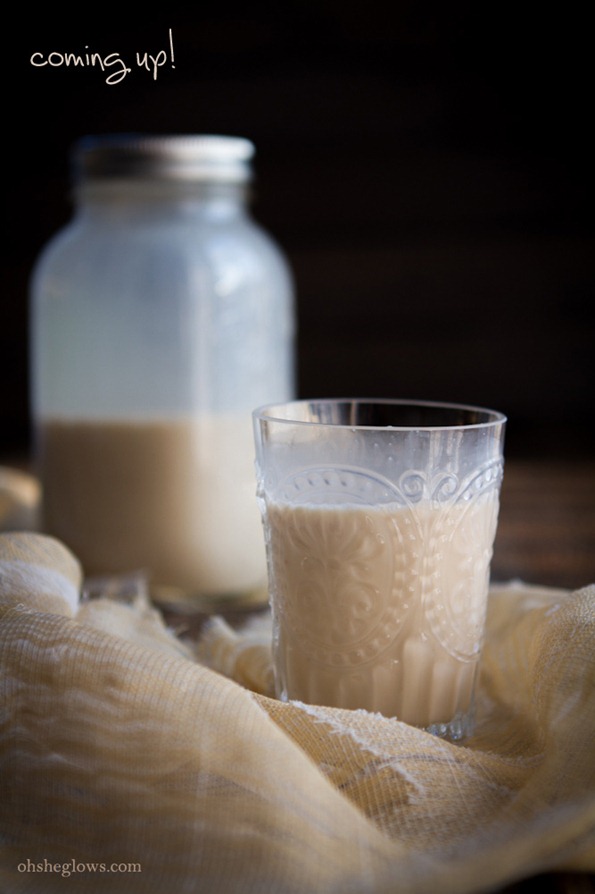
I was already planning a post on homemade milk, but now it seems even more timely and appropriate. Easy, homemade milk coming on up. I think you’ll really like the ingredients list in this one.
Have you heard anything about carrageenan before? Do you avoid it on labels or will you in the future?



You should write to PC. They are a great company and Canadian at that. They deserve to at least hear what you have to say!
Wow this has caused quite a stir! I have to say I agree with Angela when she encourages everyone to do the research and make an educated decision for yourself. Personally I avoid the stuff when I can and make homemade milk when time permits. One ingredient which I have been questioning lately which has come up in many recipes is Xanthan gum. I am back and forth on whether or not to use it given the mixed things I have read about it in my research and was wondering out of curiosity if you (Angela) or anyone else has any insights or has looked into it as well?
Cheers to a life of balance, and a lovely focus on healthy living :)
Naomi
Hi Naomi, I don’t personally use x-gum in my recipes and haven’t looked into it yet. I do think it is in some non-dairy products though (and of course gluten free) so it’s worth looking into if you are concerned about it.
Maybe I’m just at the odd of the spectrum here. . . but why is everyone so obsessed with milk substitutes at all? Why not just stop drinking milk? That’s basically what my husband and I did. We have some organic whole milk our son drinks (perhaps 1/2 a cup of) most days, and I keep a milk alternative on hand, that I use very periodically for recipes. Wouldn’t this solve most of the problems – just eat natural, whole, unprocessed foods and avoid substitutes – period.
I guess. . . this is a question to the vegan community. If you are stopping all consumption of animal products, why do you all try so hard to find substitutes? I’m not even vegan and it was easy to eliminate milk consumption (drink/recipes) – you just do it and in a couple months it’s a thing of the past. For instance, two weeks is all it takes to acquire a taste for black coffee for many people. . .
I’m actually really curious why someone who is a vegan is substituting animal foods, particularly in the long term. Isn’t that kind of, well, philosophically inconsistent?
I think calling it a ‘milk substitute’as a blanket statement is inaccurate. I enjoy drinking water, juice, coffee (although I don’t mind it black I prefer it with a little ‘toning’ down, preferably with almond milk but sometimes with a dash of vanilla extract), wine and sometimes a nutty, healthy beverage. It’s great to add to smoothies – sometimes I use water and sometimes I use almond milk. I’m not vegan, but I’m not a fan of milk. In my opinion – ‘milk substitute’ NO! A tasty healthy beverage YES!
You actually raise an interesting point, though it doesn’t have much to do with what you intended. You write “milk,” and are referencing cow’s milk (which, of course, is what we have been conditioned to associate with the word ‘milk’). However, the word has begun to adopt a secondary association- one that includes plant-based non-dairy milks, such as almond and coconut- the homemade versions of which are natural, whole, unprocessed and free of additives. Your viewpoint is relative to your lifestyle- you probably drank cow’s milk for much of your life, and so that is your milk. My son has never had cow’s milk, just almond/hemp milk, so his ‘milk’ is your ‘substitution.’ Interesting stuff!
Also, the vegan lifestyle generally focuses on what is gained by maintaining a healthier lifestyle- I don’t think many vegans think of nut milks as ‘substitutions,’ rather considering them another nutrient-dense addition to their diet. Eliminating additive-free, homemade milks altogether would deprive people of a wonderful source of vitamins and minerals, without much gain.
Finally, one of the biggest benefits of going vegan is the positive effect on the planet and the animals we share it with. By not consuming animal products, vegans spare millions of animals the pain and suffering often inflicted on them by factory farms and slaughterhouses. A person who follows a vegan lifestyle for this reason alone may very well seek out substitutes for those products that they have stopped consuming because their choice to stop has little or nothing to do with taste preferences or health. The good news is that most often, the “substitutes” vegans seek out are healthier than their less-ethical counterpoints.
I suppose it really comes down to your personal perspective- what you see as a substitution, we see as a nutritionally-dense addition to our diet. If I developed a nut allergy and had to stop drinking almond milk, I wouldn’t think of an alternative milk as a substitution. It would just be another kind of milk, another choice. That’s really what it’s all about- having choices :)
Hi Ariel!
For me, as a vegan, I don’t look for “milk substitutes.” I don’t miss the taste of regular milk at all. I did not have much difficulty giving up milk or really any other animal products.
I am most interested in trying different foods and flavors. I think hemp, soy, almond, hazelnut “milks” are a great way to get to some key nutrients and spice up your meal plan.
For many of us however, food is often very tied to our emotions and traditions. We each have a different relationship with food. Depending on that relationship, it may be more or less difficult to eliminate certain foods.
Also, for some people a substitute may be very helpful in switching to a vegan lifestyle. If milk was a staple source of calcium or protein for a certain individual, a milk substitute is any easy-go-to drink to ween off of milk. There are milk substitutes made for people who are lactose intolerant as well so they don’t just target vegans.
It terms of being philosophically inconsistent, people decide to adopt a vegan lifestyle for different reasons so it depends on the person. I think calling it a milk substitute is misleading as Sandra said below. It also depends on the person. If you’re being vegan 100% for health, you may really be looking for that substitute that tastes similar to milk. As I stated before though, I love drinking soy, almond, coconut “milk” because I think it’s fun to be adventurous with my palette :)
These are interesting. Thanks for responding. I suppose the discussion of additives to foods sparked some additional questions in my mind – to which there obviously isn’t a single or simple answer.
I actually read about this last week on FoodBabe and was shocked! Went and looked at my unsweetened, original Almond Breeze & there it was in the ingredient list!! Started making my own the next day! I’m so thankful you’re bringing attention to this on your blog so more people are aware. Thank you!
Thanks for posting this! I follow the Specific Carbohydrate Diet as closely as I can, and it is often a choice of the lesser of two evils when it comes to non-dairy milk (carrageneen and xantham gum). I’m not really sure which is worse from an IBD standpoint.
I wish people would compromise on the “milk” texture.
Thanks so much Angela for posting this. After reading this I went to buy some snacks for my daughter and low and behold it had this product in it. If I didn’t read this article I would of just purchased it.
Again thanks for posting this. Love reading your blog :)
That is crazy!!! I had no idea. Great post!
Angela-
I wanted to thank you for bringing this information to light for me. I’m a junior in high school and freshman year I had to go through a colonoscopy and found out I was suffering from a chronic inflammatory disease. After going vegan for ethical/environmental reasons, I’ve also gained many of the health benefits but after reading this, I am wholly pissed off and upset to look in my fridge and realize why even nondairy milk has been making me feel more irritable than usual. These things just make me speculate what weird ingredients like this contributed to my developing this disease in the first place and make me feel the need to speak out for a whole foods based lifestyle even more. Thanks for the PSA!
Angela, I just wanted to say thank you for these posts. They are SO helpful. I am looking forward to your homemade almond milk recipe!
My mom is highly sensitive to MSG and has avoided carrageenan for years because they are akin in many way (haven’t done my research here to explain the chemistry) but have not heard about relation to IBS. Good to know!
Hi Angela, I’m a little dissapointed about this post. I am a non-vegan, but I love your blog for its generally common sense approach to diet in general. You seem really switched on about food and food myths in general, so i found this topic suprising. The pdf link that you gave is full of links to articles ranging from the late 1960’s through the 1980’s, and in general were methodologically flawed studies. The body cannot convert undegraded carrageenen to degraded carrageenen. Searching pubmed or cochraine for evidence will confirm the lack of evidence for danger from carrageenen. I saw another user mention susan poster, who is well known as one of the greatest quacks in the nutrition world. I feel like you usually avoid fear-mongering topics and this seems to be an example of one…
Great insightful post! I’ve never heard of it either and I’m not even sure if it is used at all in Ireland but I’ll definitely be watching out for it in future!
Thanks so much for this post. I really had no idea and our house drinks a lot of almond milk.
Hi Angela, I have never commented before but I check your amazing site daily and have tried a lot of your recipes. I enjoy the Natura unsweetened soy milk. It is GMO free and doesn’t list any carrageenan. I use a splash in my morning tea and I use it in oatmeal and baking. I have been making your sweet potato oatmeal breakfast casserole every week for the last two months, I am in love. Thank you for all your hard work and yummy recipes!
I was JUST coming here to see if you’d written anything about carrageenan. What a timely post. This ingredient has ticked me off for a long time. I’ll be following up on this post and the comments. Thank you!
Also, not sure if this has been posted already but it might help – http://www.cornucopia.org/2012/05/shopping-guide-to-avoiding-organic-foods-with-carrageenan/
Wow! This is completely new to me as well….AND boo to Almond Breeze – I was a big supporter, but I will be looking elsewhere now.
Holy smokers! I live on Liberty yogurt, so will email and ask liberte yogurt if they have carageenan in their products, as its not on this list. I also drink So Delicious coconut milk, so that’s going out the window now too. Poop! My local Whole Foods carries a lot of local brands not on this list, so i wonder about the sour cream now too. I guess I will have to email them all and find out.
Thanks for such great info. Amazing all the stuff they never tell you.
THANK YOU. I drink Almond Breeze regularly and also suffer from IBS. I’m making the switch to WF.
Hi Angela!
Thank you very much for publishing this article. I am a huge label-reader and always know what’s inside my food, but I know that none of my friends do. They don’t care anyway what they eat, but I hope if people like my friends come across an article as yours, they might start to think about all these small numbers at the end of the ingredient list.
However I do not want to blame my friends for their behaviour, I want to blame the governments and the food industry (no matter in which industrialized nation you live). It’s their JOB to lead their people to a healthy lifestyle! For example, in Gemrany, carrageenan is said to be safe even though it caused inflammation and ulcers in the bowels of rats, guinea pigs and rabbits.
I’m glad to see people who have a great influence on many people (like you) talking about harmful ingredients in our food. In my view, taking action, writing articles, and buying the “right” food items can be the first step to a more consumer-friendly choice of product in our grocery stores.
Thanks again and best wishes from Germany, Lara