
First up- the winner of the Canadian Neal Brother’s Contest…
I didn’t have many people comment on the GMM, so your chances of winning were MUCH higher than usual! ;)
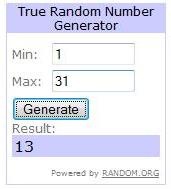
Congrats to Heather! Heather please email me your address and we will get this wonderful Neal Brother’s package sent to you! :) Thank you for everyone who made a comment on the Green Monster Movement!
~~~~~~~~
Yesterday, we did a quick grocery shop to stock up on some food we ran out of over the weekend.
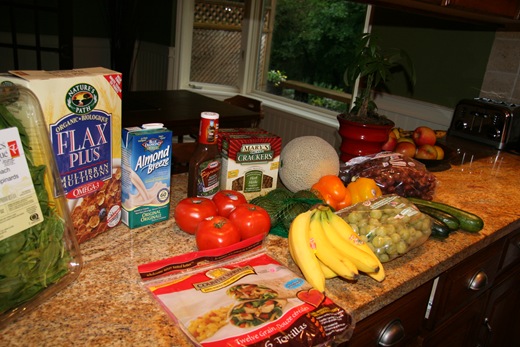
The organic grapes were on sale so we got 2 big bags! I think these are the first grapes I have bought all season because they are just so darn expensive. They are totally splurge worthy though. I had a huge bowl last night. Sadly, I don’t think they will last long in this house!
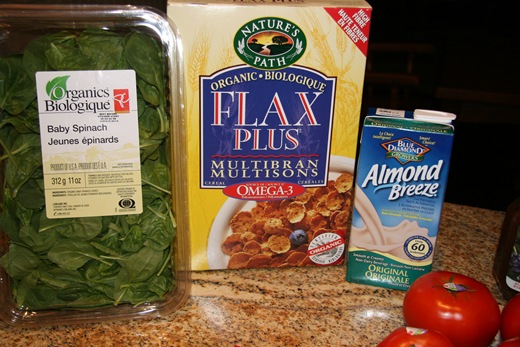
- Organic spinach on sale
- Nature’s Path Flax Plus Cereal (my new obsession)
- Almond Breeze in Original
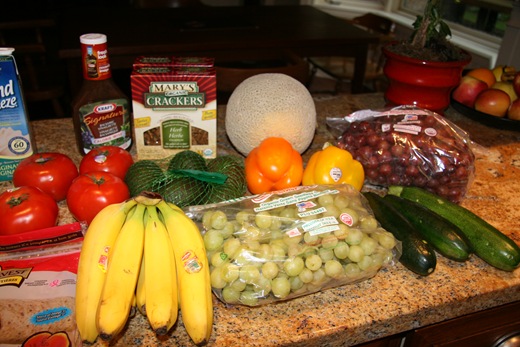
- Kraft Light Balsamic Vinaigrette
- Mary’s Organic Crackers
- Twelve Grain Tortilla Shells by Country Harvest
- 4 tomatoes
- Bananas
- Bag of avocados
- orange + yellow pepper
- Cantaloupe
- Red + green organic grapes
- 3 Zucchini
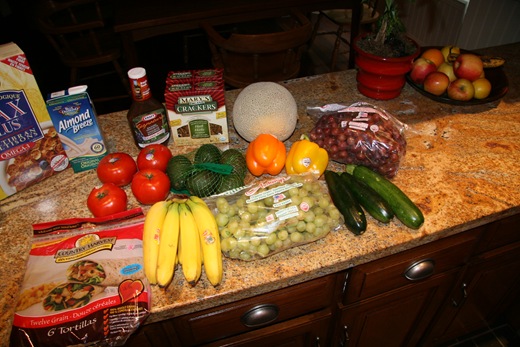
I have been asked whether I buy exclusively organic produce when I shop. The quick answer to this is no.
The more lengthy answer behind it is for a couple reasons. 1) We used to buy everything organic that our grocery store carried. Since starting up Glo Bakery however, we made many cutbacks on our spending. One of the first things that went was organic produce. The only things I tend to buy organic now are spinach, kale, apples, and tomatoes (all high risk for pesticides that I eat every single day!). I also try to buy organic tomato sauce whenever possible. However, I don’t tend to buy organic peppers, zucchini, avocados, or other produce items (especially if it has a thick skin that is not eaten) simply because of the cost.
We also buy some organic produce like grapes when it is on sale. Otherwise, everything else you see is just regular produce. And 2) Our local grocery stores don’t have a large organic section so there are many products that they simply don’t carry organic, or they do carry it, but they are never fresh. No thanks!
I am thinking about purchasing a local CSA for the fall season, but I need to look into it more and research the costs.
~~~~~
Today’s question: Do you buy any organic produce on a regular basis? Why or why not? If so, what types of things do you buy organic?




I try to buy organic when I can, but I’m not diligent about it. I buy most of my produce from a local grower, and his stuff is so much better looking/lasting/tasting/etc than the stuff at the store, that the tradeoff is that it’s non-organic, but local.
I try to incorporate organics into the items where pesticides play a big role (such as peaches, nectarines, apples, peppers, strawberries, lettuce, spinach, grapes, pears and potatoes).
OO I See Mary’s Gone crackers in there!! I love those!! I try to buy organic as much as possible but sometimes it just gets too expensive.
I’d like to buy all organic (and local), but I just can’t afford it yet. I do buy organic yogurt, though, and I love all the Nature’s Path cereals, which I believe are organic as well.
I buy organic produce when it is on sale or if I get to the farmers market. I would rather by local before I buy organic since most of the local farms are committed to organic farming anyway.
like you, i try and save some dollars these days by cutting back on organic. There are some things like spinach and apples that I do try to splurge on though. For me, it isn’t just about the chemicals used, but the quality of the soil and growing time allowed that make organic produce *far* more nutrient dense than otherwise (this was seriously shocking when I read about it in In Defense of Food…I think something like 3 apples = nutrients in 1 apple in the 20s or 30s- yikes!)
I really enjoyed reading others thoughts on buying organic. I generally don’t. I am of the mindset that it is best to buy local produce — that is just my general approach. I don’t feel right purchasing something organic, when I can support some of my small local farmers (who often times use relatively small amounts of pesticides in comparison to larger growers — or some don’t use any, but can’t afford the expensive certification process).
Buying local can, however, be a little limiting. . . I can’t purchase spinach year-round that way. So I oftne purchase organic spinach and greens b/c my husband and consume so much of them and they are higher-risk for pesticides.
I’m the exact same as you. I try to buy things like tomatoes, apples, peaches, etc organic. Everything else, I don’t normally buy organic unless it’s the same price as the inorganic variety.
I’m most concerned about my milk and meat products, because I think it’s most important health wise for those to be organic. But the price can be double, even triple, the regular price! I can’t afford that. I’d have two tubs of yogurt to live off for the week and that’s it! :P
I go by the Dirty Dozen list when buying organic. Then I just get a couple things on the organic list and most of my produce from the non organic list.
I tend to buy the dirty dozen organic when I can find them, but I have a difficult time buying organic produce that was shipped from millions of miles away versus buying conventional produce that was grown locally. It’s such a dilemma. There are many things I can buy in bulk that are much cheaper, so I go with those, especially spinach/lettuces, raspberries, carrots and celery. I ALWAYS buy organic greens and try for other things, but at this point, I can’t buy organic exclusively solely for cost alone. I know that it’s “worth it” for my health but sometimes your wallet won’t always let you.
It is such an interesting and ironic situation in the ‘western’ world–organic. When I went to Timor EVERYTHING was organic, because they coudln’t afford pesticides and/or fertilizer. The chickens were normal sized and everything was honestly picked out of the gardens or forest that day.
Thus, when I came back to Oz, I vowed to only eat organic. Yeah, it’s more expensive..but so what? It’s a little bit more…then enjoy what you’re eating and don’t waste food. I go to a local farmers market that only sells organic, and I only eat what’s in season. That’s the other thing that you should be aware of. When buying organic, you most of the time buy seasonal. Grapes shouldn’t be avaliable in winter :)
I only buy organic milk and eggs, meat from a local butcher. It’s not worth risking eating the crap that they put into everything.
Organic…more expensive in the western world, everyday life everywhere else because it’s ironically cheaper. Interesting.
Beyond that..it tastes better..it actually has flavour.
I do tend to buy all of my produce and dairy organic whenever available. Although it is more expensive, I think there are many benefits to eating organically. There are many other organic items I buy as well… pasta, crackers, all of my nut butters, cereals, etc. I think many produce items, especially ones with thick inedible skins, are not necessary to buy organically, but I just like knowing that what I fuel myself has been grown chemical free and in a healthy environment.
xxoo
Heather
hahah! My husband just said “is that our pantry? we have all that stuff”. hehe!!
I was trying to convince him to buy a CSA this fall as well, but we just read an article about a farm in Norwood, MA that cancelled their entire season! I have to research it more to see if the consumers will get their money back. yikes!
Yes yes yes definitely buy a CSA share! You will not be disappointed. Check out series of CSA posts- I’m a huge proponent of local agriculture.
Hi Angela!
I love your site, I’ve been a follower for awhile now and your site really inspires me to take care of myself!
I was wondering where you get Almond Breeze- I live in Alberta and I can’t find it anywhere!
I put more emphasis on local and fresh/seasonal than on organic.
We’re blessed here with year-round farmer’s markets, and a wide variety of produce. One of the nice things about meeting the grower is getting to discuss face-to-face how your food was raised. Most of our local farmers use no synthetic fertiliers or pesticides, but have not paid to go through the certification process (expensive in the US).